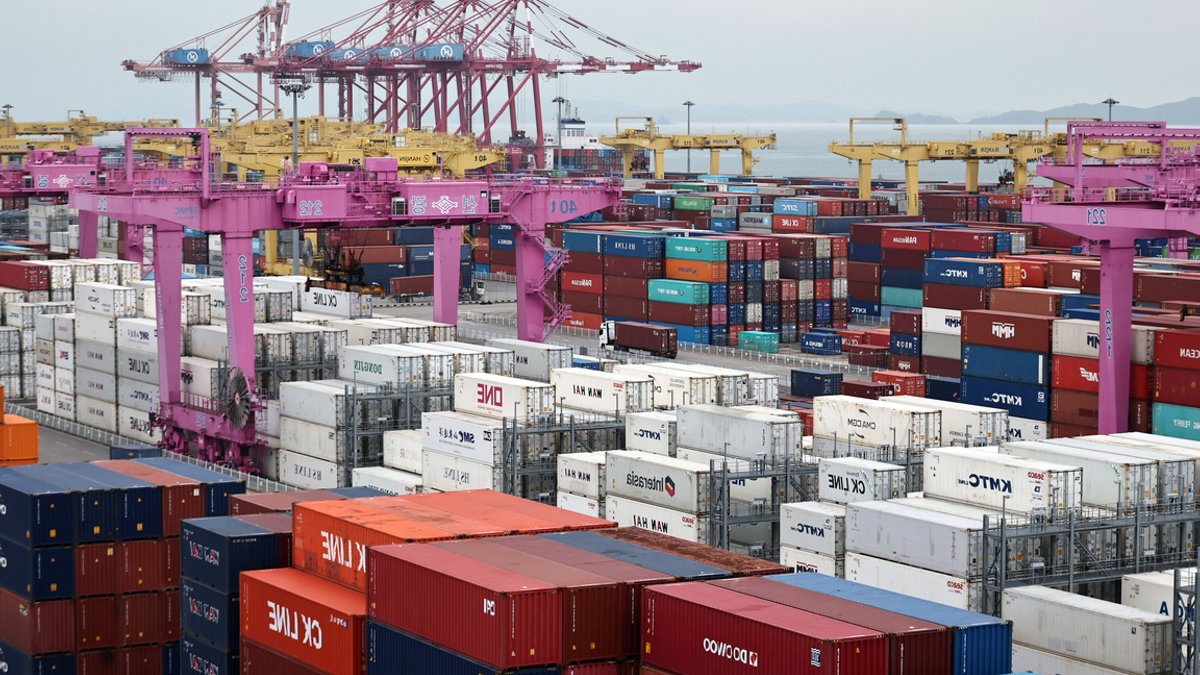
For the first time, South Korea’s annual exports have exceeded $1 trillion, becoming the fourth nation to achieve this milestone, following Germany, the United States, and China. This marks the first addition to this exclusive group since 2007, driven by a surge in semiconductor prices and shipments due to increased global spending on artificial intelligence. The cumulative exports reached this historic mark at 2:09 p.m. on Thursday, just a year after surpassing $700 billion and 62 years after hitting $100 million.
A milestone amid global rivalry
President Lee Jae Myung celebrated this achievement as the result of decades of collective effort, honoring workers who dedicated their youth to industries like garment manufacturing, shoe production, and shipbuilding. Lee emphasized that export gains must enhance the quality of life for citizens and vowed to ensure that growth benefits both large and small businesses, as well as communities nationwide.
Germany and the U.S. achieved the $1 trillion export mark in 2006, with China following in 2007, fueled by a trade boom after China’s entry into the World Trade Organization. South Korea reached this milestone despite challenges like rising tariffs and U.S.-China trade tensions, with a population of 51.6 million and a $1.88 trillion economy, smaller than its predecessors at the time. The Ministry of Trade, Industry and Resources projects full-year exports of $1.17 trillion, up about 65 percent from last year’s record $709.3 billion.
Chips lead the surge
In the first 10 months, exports totaled $930.2 billion, including $396.8 billion in semiconductors, accounting for about 43 percent of the total and nearly triple the previous record for the period. AI data center demand drove up DRAM and NAND prices, while the build-out lifted shipments of solid-state drives, transformers, cables and copper, according to the ministry. Exports excluding chips rose 20 percent, with 16 of 20 major categories gaining. Cosmetics exports reached $12.4 billion, topping last year’s full-year record in 10 months. Shipments rose in seven of nine major markets, led by China, up 88 percent, and the US, up 77 percent. Small and midsize companies also posted record exports.
Imports rose 21 percent to $635.1 billion, leaving a surplus of about $295 billion through October, against $77.4 billion for all of last year. “Part of the $1 trillion belongs to imports,” Kang said, citing steady supplies of crude oil, naphtha and chipmaking equipment. Much of the record reflects higher prices, not higher output. Kang said rising prices drove much of the growth, as AI demand sent memory chip prices soaring and petroleum product export prices jumped 62 percent to $1,105 a ton.
Structural limits and future strategy
Kang acknowledged the gains have gone mostly to large companies, citing structural limits in chips and petrochemicals, which have short supply chains and employ relatively few workers, unlike automobiles or ships. “It is regrettable that the profits have not flowed through to suppliers,” he said, adding that new chip plants and joint research with equipment-makers could spread the benefits. Normally, a large trade surplus lifts the won, because exporters convert their dollar earnings into local currency. But many keep those dollars abroad or spend them on imported parts and overseas factories, meaning less of the surplus reaches the currency market.
Kang said exports could exceed $1 trillion again next year, though easing chip and oil prices could pull them below this year’s level. He expects AI infrastructure demand to hold through the third quarter of 2027. Delays in US data center projects, Chinese competition and protectionism remain risks. Kang said Korea’s major industries appear to be undergoing a structural shift. When exports first passed $10 billion in 1977, they were led by ships, frozen fish, plywood and clothing.
Kang said Korea should not be a country that simply sells goods. Asked whether Korea would follow Japan, which came to rely on income from overseas investment after the 1985 Plaza Accord, Kang said Korea is likely to take a similar path. But he noted that Japanese companies prospered while ordinary Japanese saw fewer gains. Korea should instead keep research and “mother factories,” the advanced plants that develop new processes, at home while expanding overseas, he said.
